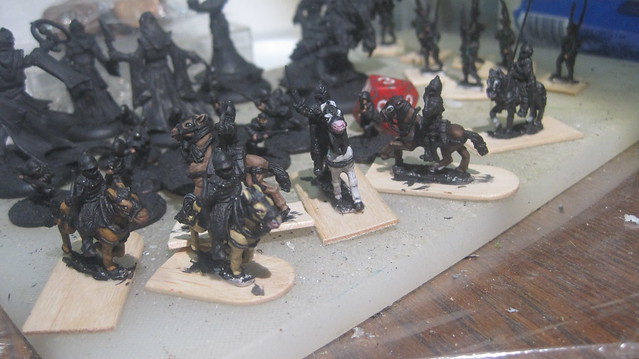
. . . and my minis on my mind.
I've been thinking of late about a project for one of the Black Book series of rules from Warlord (Black Powder, Hail Caesar, etc.). I quite enjoy them, as last week's game reminded me, and own Black Powder and the Age of Reason supplement, Last Argument of Kings. I've also been itching to work on some sort of big, long term project in the Black Powder period in 15mm. While there's real appeal to doing something for the SYW (either in Europe or the colonies), the War of the Spanish Succession (have you SEEN the new Khurasan minis?), or the Great Northern War, I have a passion for the AB range, already have some AB Russian guard, and the Napoleonic period offers a greater variety of painting options than any others. So, down the rabbit hole I go.

After some consultation (and an excellent suggestion from JJM, the THMG's English ambassador), I've decided to build some preliminary forces around the fighting on the first day of the Battle of Kulm, also known as the Battle of Priesten. It's actually an interesting engagement, in which a rearguard composed of the Russian guard corps, supported by line troops and cavalry, hold off steadily increasing pressure from the French. It reminds me a little of the first day of Gettysburg, where a small holding action gradually escalates into a massive dog pile.
With the Nafziger lists now available online, I was able to track down OOBs for both the Russians / Allies and the French. To keep things manageable, I'm going to work on the approximate scale where 1 brigade of 4-6 battalions (or squadrons) is a BP unit, and a BP brigade roughly translates into a division. While this isn't perfect (I need to fudge some of the historical formations into BP terms), it does give a reasonable organisational framework for planning out units / purchases and painting. Loosely speaking, the Russian and Allied forces break down like this:
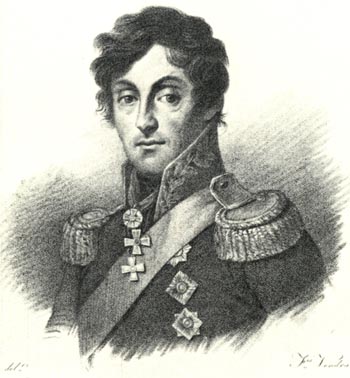
Russian / Allied General: Generallieutenant
Osterman-Tolstoy
BP Brigade 1 (Left Wing, Centre, of 1st line, General Bistrom I and Colonel Schelwinski)
Unit 1
Russian Guard Jager Regiment (3)
Murmon Infantry Regiment (2)
Unit 2
Guard Hussar Regiment (6)
Unit 3
Revel Infantry Regiment (2)
4th Jager Regiment (2)
BP Brigade 2 (Right wing of 1st line, Generalmajor Knorring)
Unit 1
Empress Curiassier Regiment (4)
Unit 2
Tartar Uhlan Regiment (6)
Unit 3
Illowaiski #12 Cossack Pulk
Unit 4
Loubny Hussar Regiment (2)
Serpuchov Uhlan Regiment (3)
Unit 5
Guard Horse Battery #1 (Bistram) (12 guns)
Unit 6
Erzherzog Johann Dragoon Regiment (4) (Austrian)
BP Brigade 3 (2nd line,
Unit
1: 1st Guard Infantry Division:
Generalmajor Baron Rosen
Brigade: Generalmajor Potemkin
Preobragenski Guard Infantry (3)
Semenovski Guard Infantry (3)
Unit
2: (small?)
Brigade: Generalmajor Krapovitzsky
Ismailov Guard Infantry (3)
Unit
3:
Guard Light Battery #1
Unit
4:
Guard Heavy Battery #2
Unit 5 Generalmajor Ljalin's Brigade, part of
Tenguinsk Infantry Regiment (2)
Estonia Infantry Regiment (2)
Grand Duchess Catherine Battalion
Unit 6:
(?) ½ Light Battery #6 (6 guns - not sure how to handle this?)
BP Brigade 4: 3rd Division:
Generalmajor Schachafskoy (part of
Unit 1
Brigade: Colonel Wolff
Tchernigov Infantry Regiment (2)
Selenguinsk Infantry Regiment (2)
Unit 2 4th Division: Brigade: Colonel Treffurt (small?)
Tobolsk Infantry Regiment (2)
Minsk Infantry
Regiment (1)
Unit 3 Corps Artillery:
Light Battery #27 (Baikov) (12
guns)
Unit 4
Heavy Battery # 14
(Cerenissomov) (12 guns)
There's also two units of cavalry, part of the guard corps, that arrived later. I'll have to figure out how to accommodate command for them:
Guard Uhlan Regiment (6)
Guard Dragoon Regiment (6)

You can see what I mean about fudging. The historical OOB doesn't fit neatly into Black Powder terms, and even approximating it leaves me with some "light" brigades and units. I can tinker with it as I go, of course, and in the mean time, it gives me something to build with. One thing I find appealing is the ability to have multiple historical units comprise a BP unit. It means more flags, more command, and more pretty on the table. As all normal sized BP units are 6 stands, I'm going to have to fudge here a little as well. The unit comprised of 3 battalions of two different guard regiments is straightforward; the one comprised of three different line units is less so. Another way to do it would be to simply total up the available batallions of each type, and arbitrarily assign them to units / brigades, but that seems a little hinky.
Anyone with experience adapting historical OOBs to game terms, I'd much appreciate any advice you can give on the process.
FMB